June 09, 2022
Between progress and risk: Green genetic engineering put to the test
Green genetic engineering has been considered one of the most controversial innovations in agriculture for decades. Its proponents see genetically modified plants as a means of increasing yields, reducing the use of pesticides and securing food for a growing world population. Critics, on the other hand, warn of ecological risks, incalculable long-term consequences for humans and the environment and increasing dependence on agricultural corporations. Between the promise of technological progress and the ecological and social dangers, the question arises as to what contribution green genetic engineering can actually make to sustainable agriculture - and where its limits lie.
Green genetic engineering refers to the use of genetic engineering techniques in plant and animal breeding to give them certain characteristics or remove undesirable characteristics. It is used in agriculture and the food sector in 27 countries worldwide. Over 90 percent of the global cultivation of genetically modified organisms (GMOs) is accounted for by just five countries: the USA, Brazil, Argentina, Canada and India.
In Europe, the use of green genetic engineering is the subject of an ongoing social debate. To date, genetically modified plants have only been cultivated on European soil in Portugal and Spain.
GMOs may not be cultivated in Switzerland. However, the import of GMO food and animal feed is already permitted. Although it is possible to import GMO animal feed into Switzerland, no use has been made of this option to date¹. The approved additives and processing materials are also not to be found in the retail trade. In spring 2025, the National Council and Council of States extended the moratorium on the cultivation of genetically modified plants in agriculture by a further five years until the end of 2030. New genetic engineering methods such as genome editing with Crispr/Cas9 are also included in the moratorium.
No trend reversal in sight:
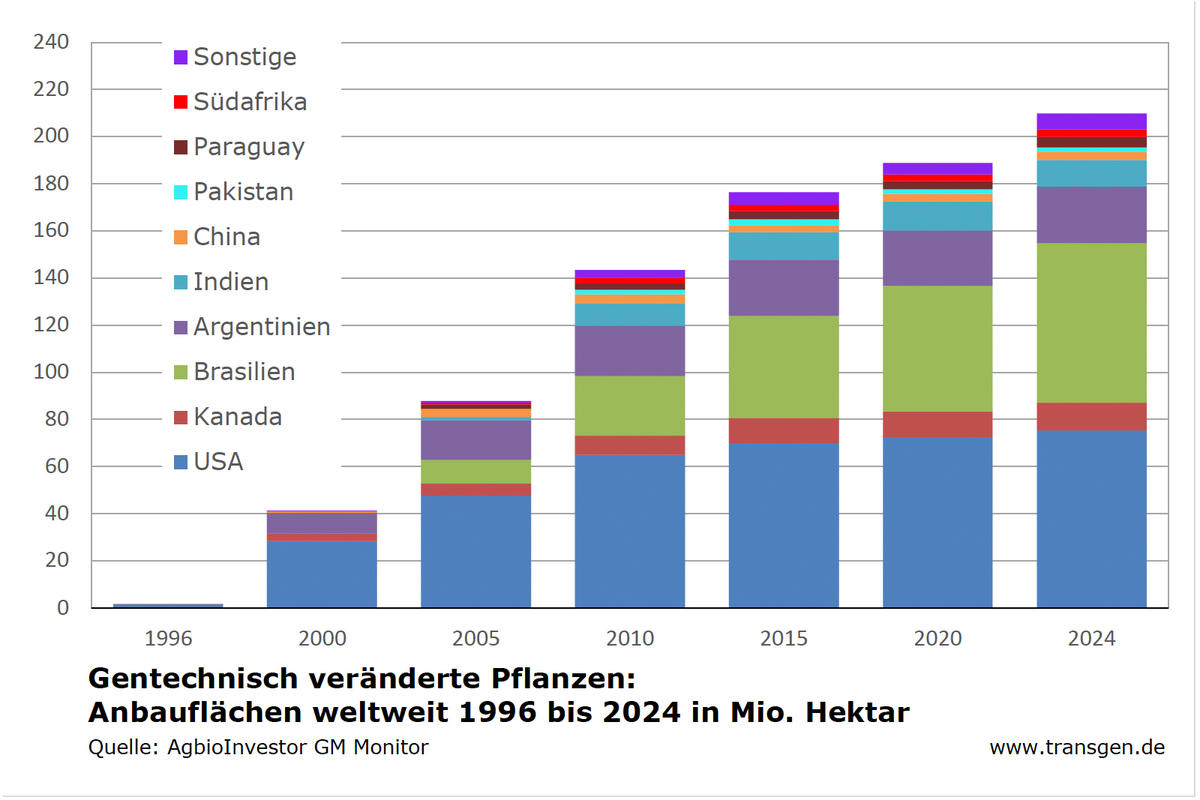
Due to political and scientific developments, Forma Futura 2022 once again took a closer look at green genetic engineering and the new genetic engineering processes and has been following the topic continuously ever since.
There are currently two main uses of GMOs:
- Through genetic modification, plants contain a poison that kills pests and makes the plants resistant.
- Genetic engineering is used to make plants resistant to certain pesticides so that fields can be sprayed and only the weeds are destroyed.
In the food industry, food is modified so that it contains more nutrients and vitamins or has a higher protein content.
- Damage to health, allergens: The risk of damage to health from genetically modified food is to be classified as low or equivalent to conventionally produced food. Genetically modified raw materials are subject to extensive testing and are not approved if allergenic potential is suspected. An influence on increased antibiotic resistance is considered unlikely.
- Ethical concerns: No ethical limits are seen for plants. However, genetic modifications to animals are hardly accepted by society - and yet they do take place. The borderline area already begins with cross-species mixing, for example of microorganisms and plants.
Fact check of the most important advantages of green genetic engineering
- It should be possible to adapt crop varieties more quickly and effectively to market requirements. This should enable more yield on less land. -> The methods have the potential to increase agricultural yields. However, this is heavily dependent on environmental conditions, cultivation management and regulatory and social framework conditions.
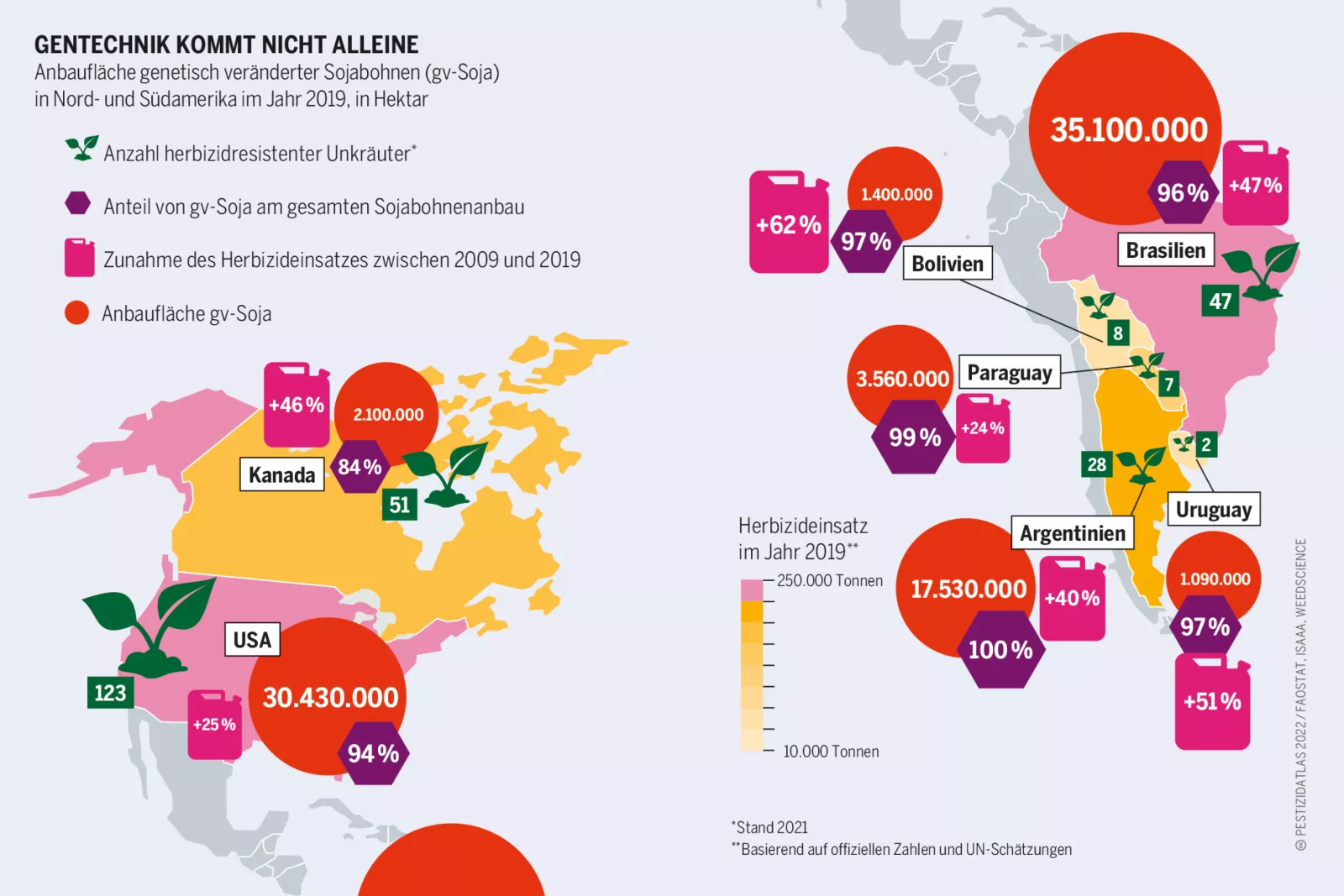
- It should be possible to reduce the use of pesticides. This could protect the health of farmers. -> Especially in soybean cultivation, the increased use of pesticides goes hand in hand with the cultivation of genetically modified seeds, as this graphic clearly shows.
In addition to the benefits of green genetic engineering, the technology also harbors some risks:
- Increased dependence of farmers on seed companies due to the long-standing patent protection of GM seeds
- The migration of GMOs into natural habitats or neighboring fields cannot be avoided.
- Damage to non-target organisms by genetically engineered insecticides in crops
- Development of resistance in weeds and insect pests, which in turn requires the development of new GM varieties and pesticides
- Reduction in biodiversity due to displacement by GM varieties, leading to susceptible monocultures
What is Forma Futura's position on new gene modification technologies such as CRISPR/Cas9?
Until now, genetic engineering methods have mainly been used to develop herbicide- and pest-resistant plants. In this genetic engineering process, the location of the insertion of a new gene segment could not be controlled and more complex genetic modifications could hardly be produced. With the new genetic engineering methods, it should be possible to modify the genetic material and gene regulation in a targeted, planned manner and without significant side effects.
"At present, the risk assessment of the new genetic engineering methods is based on very weak data and limited experience."
As there are still many uncertainties with the new technologies, Forma Futura relies on the precautionary principle and chooses to assess companies on a case-by-case basis due to the unforeseeable consequences and effects on ecosystems and social structures.
Company dialog on the use of green genetic engineering
Companies that generate sales with genetically modified seeds, pesticides, fertilizers or animal feed are analysed particularly critically by Forma Futura. In the case of companies in the food sector, it is very difficult to assess whether they have recourse to GMOs and use them. This is due in particular to the lack of transparency on the part of companies.
For this reason, Forma Futura contacted the potentially affected companies. During the dialogue, the key issues were their attitude towards GMOs, the share of sales of products affected by GMOs and transparency towards their customers (labeling of GMO products). Fortunately, it turned out that all but one of the companies contacted in the investment universe allow consumers to choose non-GMO products. They also focus on a high level of transparency and were able to explain their attitude and principles regarding the use of GMOs in a comprehensible manner. Despite a very constructive and transparent dialog, we excluded the US company Campbell Soup Co. from the investment universe in 2022, as GMOs account for more than 99% of its sales and consumers therefore have no choice.
The issue of green genetic engineering showed us once again how important transparent reporting and a solid data situation are for our assessment of companies. We will continue to be in contact with companies and call on them to increase their transparency.
Similar posts
June 1, 2026
CAPITAL WITH IMPACT
Through Forma Futura Invest AG, founding partner Antoinette Hunziker-Ebneter and co-CEO Larissa Jäger focus on companies that make the greatest possible contribution to a sustainable economy and society. But how does a sustainable asset management firm successfully navigate times of ESG backlash, greenwashing, and greenhushing?